Conversations With My Mother

Sometimes, in my dreams, I talk to my mom.

I don’t remember which topics we touch upon, nor do I have any recollection of what we were doing, where we were, or why we were there in the first place. All I know is, when I wake up, I wish I hadn’t, and when I turn my head toward the wall, shut my eyes and try to fall back asleep to continue our discussion, she’s gone again.

There are many conversations I never got to have with my mom, and only near the end of her life did I even feel comfortable broaching my real emotions with her. At 16, I was still figuring myself out, and in many ways, I wasn’t ready to have adult conversations with her, or with anybody else for that matter.

I never asked her what music she loved; never heard many stories about her childhood; never really talked to her about love, relationships or death. Some days, I just want to know silly, little things that other people know about their parents. In the time I had with her, I never got to sort it all out.

My mom’s instinct wasn’t to share every little detail, and it wasn’t because she was insular, cold or withdrawn. It was simply because she’d much rather ask a person about their day than tell them about hers. Conversation is often a covert competition for airtime, and my mom never put up much of a fight. She would have made for an excellent interviewer, because she couldn’t have cared less that the person at the other end of the line knew how smart or witty or perceptive she was. She’d just dial, say hello, ask and listen.

I often think about her daily phone call routines, and I’ve surmised that when she died, the landline lost its most faithful user. She’d sit at the kitchen table, phone in hand, and dial the numbers of no fewer than 30 people she’d check in on. She knew every number by heart, and I spent much of my childhood sitting beside her and waiting for her to hang up. She’d put her finger up to say, “Just one more minute.”

IMG_4027

When she went to the hospital, for treatment for leukemia, our house became quiet. The phone didn’t ring as much. Instead, people called her hospital line, or her cell-phone.

She wasn’t around when texting was common, and I’m grateful for that. I don’t know that five years after her death I’d be writing about her most-used emojis, abbreviations or the time she “K’d” me. When she talked on the phone, my mom’s voice—and not just the sound—came through clearly.

Before my mom went to the hospital, the longest I’d been away from her was three weeks at summer camp. I didn’t have a phone to call her with, so she’d send letters, and while other campers might have gotten cookies, comic books or candy in the mail, I wasn’t jealous at all.

My mom’s letters were inventive, not simply postcards purchased at a dollar store. She wrote with whatever she could find at the cottage; one day, I got a letter written in a spiral on a coffee filter. She’d send crosswords for me to try, and sports pages for me to pore over. When she went to Israel one year, she sent me a handwritten note from Jerusalem, written on stationery from a hotel she was staying at.

Her handwriting was unique, an all-caps font with A’s that looked like triangles. Today, if I find anything with her writing on it, I make sure to save it. I have the crossword book she almost finished in the hospital, and I debate whether she’d want me to step in and fill in the clues she couldn’t or didn’t. I have all her camp letters in a drawer, and I sometimes get teary-eyed when folding T-shirts out of the laundry and seeing “BEN W” written on the tags.

Once a person is gone, you cling to the fragments of them that remain: their writing, their clothing, their voice. And when I began to understand she might one day be gone, I decided to try to save her voice.

This is just as I like to remember her. Soft and welcoming, with a cup of coffee in her hand.

On days when I couldn’t make it to the hospital, I’d sit at my desk, open up my computer’s recording program, and click the red button before calling her and turning my phone’s volume as high as it could go.

My voice on those phone calls is nasally and high, a combination of embarrassment with my changing body and a desire to be a kid again. We talked about annoying teachers and coaches, tests and how she was feeling during chemotherapy.

In the conversations, it’s clear what my intentions are. This would be my treasure trove of her voice, and I tried to coax her into giving me as much motherly advice as possible so I could create an archive of wisdom for when I’d inevitably need it.

My physics teacher excused me from writing a test and she told me to not procrastinate or take the easy way out. She told me to be ready for school in the morning, and that me, my dad and my sister had to be tolerant of each other. I should take ownership for my behaviour. I shouldn’t worry too much about the girl who didn’t like me back. “She’s just being a teenage girl.” I shouldn’t let what was happening to my mom ruin my life, she told me over and over. No matter what, every phone call ended with her saying she loved me.

Those conversations were vital, and even if she was in pain, my mom never showed it.

A month before she died, on Sept. 30, I recorded a snippet of her conversation with a family friend. “It’s gorgeous outside,” she said. “Go sit outside, while you can. That’s my attitude.”

About three days after she died, my computer did too. In addition to losing her, I was about to lose her voice. I panicked, and my best friend drove me to the Apple store with a terabyte hard drive in tow. He reassured me the computer would survive, and soon, every single one of my files was on the drive. The employee wiped the computer clean, and then re-uploaded every file into a folder called “Ben’s Computer.”

We brought the computer back to my house and set it up. We heard the bing, and with it came hope that my phone calls were still there. When I clicked on the file “Mom February 27 2012” and heard her say hello, I lost control.

Five years later, I’ve only listened to the tracks a handful of times. I recorded them with intentions of preserving my mom’s voice, and without them, I’m afraid I might have already forgotten what it sounds like.

The conversations weren’t as deep as I wish they were, and dealt more with my problems than they probably should have. We spent more time talking about my soccer and basketball games and her hospital food than we did the meaning of life or things my mom wished she could have done.

But I realize we talked about the every day stuff because that’s what my mom had always done, and she listened because that’s all she ever wanted to do. Before my mom got sick, I hated talking on the phone; now, like her, I loved it, and I was clamouring to get to my room and dial 791-3357, a number I’ll never forget. I’ve called it since to see if it’s been reassigned, but I tend to chicken out before I find out.

In the background of one my last recorded calls with my mom, my dad yelled up from the main floor to tell me that dinner was ready.

“Just one more minute,” I told him.

http://www.llscanada.org/


Best Stuff I Read This Year

On my first day in reporting class at the Ryerson School of Journalism, instructor Kevin MacLean gave my class some tips.

He talked about the importance of accuracy, proper grammar and concision. A “fail-worthy error” would result in a zero on what otherwise might be the best article ever written. When he returned assignments, Kevin referred to it as a post-mortem, and if you made it through that process unscathed, you could stop sweating… until next week.

Throughout the year, Kevin drilled his methods into my head. I saw commas in my sleep and proofread every assignment at least 30 times before I handed it in to him. MacLean was easily the best teacher I’ve ever had at the university level, but as much as he stressed the importance of good writing, he believed that good reading was just as essential to journalism students.I have compiled a list of the best written pieces that I have come across this year. These pieces are not all from 2015, but they contain elements of what I believe to be the best that journalism has to offer:

The Last Years of Ernie Banks

Ron Rapoport, Chicago Magazine—- @rjrapoport

Link: http://www.chicagomag.com/Chicago-Magazine/October-2015/Ernie-Banks/

The best profile writers can take an unknown entity and make us wonder, “How did I miss this?” They can also take somebody we thought we knew all about and make us ask, “How the hell did I miss that?” In his Chicago Magazine profile/tribute/obituary to Ernie Banks, Ron Rapoport takes the second approach. “Just as he was defined by his image,” Rapoport writes of Banks. “So was he imprisoned by it.” Rapoport draws on past experiences with Banks, from working on a never-ready autobiography to several run-ins with the Cubs legend, to create a beautiful, depressing, deep and enlightening piece of journalism.

A Sense of Where You Are

John McPhee, The New Yorker (1965)

Link: http://www.newyorker.com/magazine/1965/01/23/a-sense-of-where-you-are

This year, I discovered the work of John McPhee almost by accident. In a used book store in downtown Toronto, a copy of A Sense of Where You Are dropped right in front of me. I got home and looked it up, and absorbed the original profile of Bill Bradley, which first appeared in the New Yorker in 1965. McPhee makes sports writing much more than a recounting of games and practices. In A Sense of Where You Are, the writer makes obvious just how different Bradley— a Rhodes Scholar and superstar basketball player at Princeton University— was from his peers. In terms of literary non-fiction, McPhee’s work still stands 50 years later as one of the seminal works of the genre.

The Big Comeback of Benjamin Hochman 

William Powell, St. Louis Magazine—-@WPowell19

Link: http://www.stlmag.com/news/sports/benjamin-hochman-comeback/

From the moment William Powell introduces Ben Hochman in this piece, it is impossible to not root for him. That makes the ensuing lows that much more shocking, and the moments of hope that much more meaningful. Powell gives a full and descriptive profile of Hochman, a writer from St. Louis who experiences lots of heartbreak and personal difficulty before getting his dream job as a columnist for his hometown paper. Hochman’s story is so enthralling because it is so relatable. It’s about dreams and love and friends and joking and growing up and family. And it’s about baseball, on top of all of that.

Terry Gross and the Art of Opening Up 

Susan Burton, New York Times Magazine— @burtonsusan

Link: http://www.nytimes.com/2015/10/25/magazine/terry-gross-and-the-art-of-opening-up.html?_r=0

I only began listening to Fresh Air, Terry Gross’ podcast/radio program in August, but since then she’s become something of an idol of mine. Gross asks questions and gets intriguing, thoughtful answers. In Susan Burton’s profile of Gross, we learn just how hard Gross works to get that result. She’s been the host of Fresh Air for over 40 years, and has done over 13,000 interviews. Her life has been an interesting one on the surface, but when Burton gets Gross to herself, she becomes so much more than the voice asking the questions. She becomes real.

The Cruel Tutelage of Kevin Garnett

Jackie MacMullan, ESPN The Magazine

Link: http://espn.go.com/nba/story/_/id/14172961/the-cruel-tutelage-kevin-garnett

Kevin Garnett has started a new career without leaving his old one. Jackie MacMullan, one of the best working sportswriters in the world, does an outstanding job explaining how The Big Ticket has changed over his 20 years in the NBA and how he was affected by the death of Flip Saunders, the man who brought him back to Minnesota last season. If anyone ever says a woman can’t write sports, first, slap them. Then show them a picture of Jackie MacMullan. Then throw this masterpiece of sportswriting in their face.

Reaching My Autistic Son Through Disney 

Ron Suskind, New York Times Magazine— @RonSuskind

Link: http://www.nytimes.com/2014/03/09/magazine/reaching-my-autistic-son-through-disney.html?_r=1

This is one of the best stories I’ve ever read about family. Ron Suskind’s look into his amazing son Owen will make you reread sentences in awe. If a Disney movie has ever meant something to you, this story will make you want to rewatch every VHS you own. I won’t give any spoilers, but this story is just unbelievably touching and special.

Slipping Away

Shannon Proudfoot, Maclean’s— @sproudfoot

Link: http://site.macleans.ca/longform/alzheimers/

“Jo Aubin has Alzheimer’s. He’s 38.” That’s the blurb underneath the title of Shannon Proudfoot’s outstanding longform piece for Maclean’s. What follows is a powerhouse combination of anecdote, science and character study. What Proudfoot has done with this piece is show the deep effects of a disease on a person, his friends, his family and his career. In that light, this is one of the most important stories in recent years. By focusing on Aubin, a young teacher full of life and joy, Proudfoot shows just how debilitating the disease is, and how disproportionate our response as a society has been to beating it. You’ll never forget this one.

Death and the All-American Boy

Kitty Kelley in The Washingtonian (1974)

Link: http://www.washingtonian.com/articles/people/joe-biden-kitty-kelley-1974-profile-death-and-the-all-american-boy/

This profile of now-American Vice President Joe Biden is over 40 years old. In the time since, politicians have become closed, for the most part, and unwilling to be vulnerably portrayed by the media— at least not voluntarily. In Kitty Kelley’s profile of him, Joe Biden opens up. He was a political golden boy, but couldn’t hide the sorrow that consumed him. These types of profiles successfully humanize politicians, in ways that won’t, and sadly may not, be possible today for most political leaders.

Epic Blue Jays–Rangers seventh inning will be talked about for years

Bruce Arthur, Toronto Star— @bruce_arthur

Link: http://www.thestar.com/sports/bluejays/2015/10/14/epic-blue-jaysrangers-seventh-inning-will-be-talked-about-for-years-arthur.html

Bruce Arthur is Canada’s best major sports columnist. Here, he takes one of the most memorable and bizarre moments in Blue Jays history and turns it literary. Arthur truly shows what a few inches on a piece of paper can do when filled in with the right words. He writes that we’ll remember the game, but after reading his column, I’ll always remember Bruce Arthur remembering for us all.

Where the dugout is a stage and baseball is a reason to sing

Andrew Keh, NY Times— @andrewkeh

Link: http://www.nytimes.com/2015/09/18/sports/baseball/where-the-dugout-is-a-stage-and-baseball-is-a-reason-to-sing.html?_r=0

Andrew Keh is one of my favourite sports writers. That’s largely because of his willingness to write something different. Sports writing can be monotonous; Andrew Keh seems aware of that. In his reporting on “cheer leaders” in Korean baseball, Keh sheds light on how America’s pastime isn’t limited to our part of the world. This story stands out because of its detail, how it explains but never lectures, and how it makes something very foreign-seeming familiar to the reader. This is the type of work Keh puts out consistently: Stories which break the monotony.

The End of the Hoop Dream

Jordan Ritter Conn, Grantland— @jordanconn

Link: http://grantland.com/features/jon-solomon-profile-german-basketball-import-exposure-tour-international-players/

When I finished reading this story by Jordan Ritter Conn, I read it again. His profile of Jon Solomon, a basketball hustler trying to make dreams come true, is, like Solomon, flashy but, unlike Solomon, full of substance. Solomon is a writer’s dream: difficult, dedicated and a little bit insane. Ritter Conn does his subject justice here. If you’re in need of an outstanding outsider story, similar to Keh’s work, you’ll love this. “Jon Solomon will do whatever it takes,” is the kicker of Ritter Conn’s lede. He isn’t exaggerating.

The Mysteries of Pitching, and All That ‘Stuff’

John Branch, NY Times— @JohnBranchNYT

Link: http://www.nytimes.com/2015/10/04/sports/baseball/the-mysteries-of-pitching-and-all-that-stuff.html

John Branch can do anything with a keyboard, it seems. He’s won a Pulitzer. He wrote a heartbreaking book about Derek Boogaard. And he remains a dedicated and hardworking journalist. Overall, you could say he’s got some great stuff. Here, Branch mocks “stuff”, a term which has become so ubiquitous with pitching that it has lost whatever meaning it had to begin with. This piece also has a great rhythm with it. If you hear words in your head as you read them, this story is even more delightful. Great stuff, Mr. Branch.

Mr. Bad News

Gay Talese, Esquire 1966

Link: http://longform.org/stories/mr-bad-news

In September 2014, a cousin told me to check out “Frank Sinatra Has a Cold,” a piece which stands, by most accounts, as the greatest Gay Talese story and one of the greatest magazine stories of all time. Most accounts, but not Gay Talese’s. Talese has said that this story, a profile of a New York Times obituary writer, is his favourite and his best. I’d have to agree. His Sinatra piece was genre-defining, but Talese’s depiction of Alden Whitman is superior, perhaps both because and in spite of its relatively lesser renown.

Jason Rabedeaux Was Here

Wright Thompson, ESPN The Magazine

Link: http://espn.go.com/espn/feature/story/_/id/12636370/former-utep-coach-jason-rabedeaux-death-remains-mystery

Wright Thompson captures the essence of despair with his profile of Jason Rabedeaux, a former head coach of UTEP’s men’s basketball team. Thompson could’ve easily overwritten or dressed up the man’s fall from grace. Thankfully, he doesn’t, and he honours Rabedeaux with honesty and thorough research. Read everything Wright Thompson has ever written.

In an hour, a church changes forever

Link: http://www.postandcourier.com/article/20150619/PC16/150619306

2015 was defined by tragedy. No newspaper piece I’ve read better shows that than this one from the Post and Courier following the Charleston church shooting. The reporting here is descriptive, disturbing, and as perfectly done as it could have been. “But 12 remain to worship,” is a bit I’ll never forget reading. “He killed everybody,” she says. “They’re all dead,” is another.

The Friend

Matthew Teague in Esquire

Link: http://www.esquire.com/lifestyle/a34905/matthew-teague-wife-cancer-essay/

This was a story that I originally didn’t want to read. A lot of people send me stories about cancer, saying things like “thought of you” or “thought you might be able to relate.” Those sentiments are swell, but they piss me off. Every cancer experience is a different cancer experience. Eventually, I got around to reading it, and regretted not having done so sooner. Matthew Teague writes a spectacular essay on his wife’s cancer, and the friend who helped keep him from falling too far. When you read this story, think about your spouse, your parent, your sister, your brother or any other relatives, but mostly, think about your best friend.


Michael B. Jordan, Ryan Coogler and the Symbolism of “Creed”

In 1976, Sylvester Stallone teamed with director John G. Avildsen to introduce to the world Rocky Balboa, a mumbling, rumbling Philly underdog. Rocky was and arguably still is the greatest rags-to-riches sports film ever shot, but today, Rocky Balboa’s underdog story seems too familiar, too often imitated by studios with clunky vision and overindulgently melodramatic undertones. The original production spawned a series of critically hammered sequels, which were decidedly referential to their original material.

Rocky, the underdog movie, written by an underdog actor and produced on an underdog budget, has defined sports cinema, and in doing so, has become a heavy favourite. Rocky has been having an identity crisis.

In 2015, Ryan Coogler, who previously impressed with 2013’s Fruitvale Station, has joined with Stallone and Michael B. Jordan not to reintroduce everyone’s favourite pugilist to the world, but to redefine underdog culture through methods normally unused, if not unavailable, in the 1970s. Coogler has spun the original film on its head while remaining referential to it. Where Coogler succeeds is in his approach to reference, at once acknowledging the obvious connection to the original while maintaining his distance, a clever, calculated means to a satisfying and symbolic end: the cultivation of our era’s self-inflicted underdog, a product of our institutional ignorance.

Jordan, who plays original Rocky competitor Apollo Creed’s son Adonis, is the mirror opposite of Balboa: rich, educated, black. Very early on in the film, Jordan is seen wearing a shirt and tie at his workplace, a finance firm. He has gotten a promotion. He lives in a mansion after spending the better part of his childhood in group homes. He has already found his storybook ending. He has already “made it.” He doesn’t need to hustle. He can sit back. But he can’t, and he doesn’t. Adonis wants to be a fighter, later telling Rocky that he had no other choice.

This admission from Creed, who would rather be referred to as Donnie Johnson, so as to build his own legacy, brings to mind Ta-Nehisi Coates, a writer for The Atlantic, a 2015 National Book Award winner for “Between The World and Me”, and as of October, a recipient of the MacArthur Genius Grant. Coates’ work has been lauded, vilified and consumed. He is fast-becoming an increasingly important cultural voice, a critic unafraid to criticize harshly. But if you have managed to read either Coates’ work in The Atlantic or his latest book, it’s clear that he acknowledges a systemic issue in America: being a minority is frightening, and to many people, encountering hatred leaves them but one option. They must be prepared for a seemingly inevitable fight, though not necessarily with their fists. Coogler’s Creed sees no other choice. So he puts on his gloves, he breathes achingly—whit whit whit, whoo whoo whoo— and he jabs.

When the boxer packs up and moves from his Los Angeles mansion to a small, old Philadelphia apartment, Coogler manipulates, perhaps unintentionally, Creed’s re-entry into the life he felt he should have had. Poor is what he thought he was, and fighting is what he was conditioned to believe was required of him. When Creed enters Balboa’s neighbourhood, the contrast between the two becomes ever evident. Balboa had to fight because it was his way out, Donnie Johnson fought because it was his way back in.

As Rocky, Stallone punched dead meat. He ran through the streets of Philadelphia with the wind in his hair and the children of his neighbourhood following behind, cheering. White kids. Stallone wore a red headband, a nondescript grey sweatsuit and a look of determination on his face. In the background, American flags fluttered in the cool breeze. Glorious.


After Rocky reluctantly agrees to train Creed in the latest film, he sends him running through those same streets. Creed wears a grey sweatsuit, emblazoned with the Nike swoosh, along with very expensive runners. He runs across a bridge, with Sly looking down on him, both alone, both plugging along.

Later, after the pair become closer and the elder statesman is diagnosed with non-Hodgkin Lymphoma— “He’s too macho to do chemo,” the grasshopper says angrily— Jordan has his moment of running through the streets with the kids, but not before Stallone gives him some wisdom, telling him that his only enemy in the ring, and in life, is the man in the mirror.

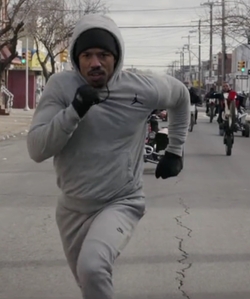
Now, Creed wears an Air Jordan sweater, Nike shorts and even more expensive runners. He sports a moustache and a goatee, a black toque, and most importantly, a hood. In Fruitvale Station, the film that signalled the arrival of both Coogler and Jordan as future Hollywood forces, Jordan’s character Oscar Grant wears a black hoodie and a black toque as well.

In that film, based on real life events, Jordan’s character is shot dead. Grant was killed on New Year’s Day 2009, and deaths like his, at the hands of armed officers, are all too common in the U.S. Trayvon Martin famously was shot by George Zimmerman, a man who let his panic end an innocent person’s life. Martin wore a hoodie.

As Creed, Jordan catches elusive poultry. He runs through the streets of Philadelphia with his hood affixed to his head and the children of the neighbourhood following behind, riding motorcycles, speed bikes and pimped out ATVs. Black kids. Jordan wears expensive clothes and a look of possession on his face. In the background, no American flags fly. Only leafless trees line the streets, and all that hangs from the telephone wires are sneakers tied together, which generally signal activity related to drugs, violence or gangs. There is no glory on the surface of Coogler’s Philadelphia.

Malcolm Gladwell, a staff writer for The New Yorker, published David and Goliath, a collection of essays and insights into underdog culture, on October 1st, 2013, roughly three months after Fruitvale Station’s release. Gladwell’s book takes its theme from the biblical battle between his eponymous characters.

“Now why do we call David an underdog? Well, we call him an underdog because he’s a kid, a little kid, and Goliath is this big, strong giant,” Gladwell says in a Ted Talk. “We also call him an underdog because Goliath is an experienced warrior, and David is just a shepherd.”

Looking at Creed with this ethos in mind, the young black boxer, a representative of visible minorities, is doing battle with the big, strong giant of the institution of racism and the constricting macrostructure of race itself.

When Creed is given his inevitable Rocky-esque challenge from a champ, he confronts this giant head on, or rather, Hood On.

At a London press conference before his fight with British boxer and world champ “Pretty” Ricky Conlan, Creed is constantly interrupted by that looming giant. Whenever he opens his mouth to give humble, thoughtful responses to a gaggle of media members, Conlan pipes in and reminds his opponent that he is nothing. Creed, clad in a shirt and tie once again and sitting next to a fading Balboa, is egged on and when he finally responds to Conlan, fists become involved. This is the inevitable fight of Creed. Not the battle in the ring, but the one he has always had to worry about. Encounters like these are the reason he “has no choice.”

Conlan arrives to their final bout to cheers, behind a fire-breathing display, later emerging from behind a smoke machine’s dense product. In this corner, the giant stands. In the other, David waits, sling in pocket.

Coogler’s orchestrated fight lasts the full 12 rounds, and Creed finishes bloodied and woozy, with his left eye swollen so badly that it looks less like an eye than a kneecap. When the bell rings, Creed put in his fight, his obligatory battle, but loses to Conlan, who only after proving his superiority shows a morsel of respect to his foe.

“You’re the future,” he tells him, which is as much literal as it is metaphoric. If Creed’s David is the future, then Conlan’s Goliath is the past.

It is a hopeful statement, but it begs the question of when. When will the politics of a country change so as to not make fighting a predisposition? When will police brutality get an appropriate punishment? When will kids be able to run through the street, wearing whatever they want without worry?

Coogler doesn’t know when, he certainly cannot say how, but he never set out to answer those questions. He only wanted to show the world what we’re always fighting against: Ourselves.

Blink: A reflection on jealousy, coming home, and three years since my life changed forever

“Take one, everybody take one,” the elderly man implored. “I’ve got plenty.”

As he swivelled on his bar stool with a glass of Stella Artois nearby, the man, who I’ll call Jim, smiled widely. The trinkets he handed out were small rectangular pouches fashioned out of old samples of fabric.

“Here, this one is masculine,” he said proudly as he handed it to the bartender. “Never know when you’ll need one.”

The bartender extended his hand and grabbed the pouch, feeling it with his fingertips and examining it carefully with his eyes as an appraiser would on Antiques Roadshow.

“You can put anything in it,” Jim said as he modeled the piece. “Loose change? In the pouch. Mints? In the pouch. If you’re a lady and have lady products. They can go in the pouch. It fastens here, and you put it in your pocket or purse, no more clutter.”

Jim was a master schmoozer. Quickly, he waved over the waitresses near him. “Take this one, you’ll like the pattern,” he said to one. “Look at that, fits right in your pocket, I told you!”

People around, including myself, snickered at it. It was a sewn pouch with a button. But the bartender was strangely intrigued, even asking for one for his daughter. “Free of charge, I have thousands,” Jim said.

“It’s just so well-sewn,” said the bartender, bald with a black chinstrap beard and a tattoo of five Chinese figures on his left forearm. “It’s just so simple.”

“It’s not simple! Do you know how hard my mother worked to make this?” Jim, 77, snapped. “Not many people could make this.” The bartender, obvious in his regret, rubbed his forehead, careful in his choice of words. He still wanted a tip.

“I’m sorry, I didn’t mean it was simple in its structure, just in its concept. When did she make these?” the bartender asked, making a safe assumption that it was long ago.

“Not too long ago. She just turned 98.”

——-

By my math, Jim’s mom was 21 years old when her son was born. She is 98 now. She has been his mom for 77 years, or 25 years longer than my mom was alive. That math seems to check out.

I usually resent people like Jim. He has been alive for so long, but still has a mother. He still talks to his mom frequently, but unlike in my case, she responds. He can hold something she made in his hands and not tear up. He can talk about her in the present tense. He can talk about her without looking longingly into empty space. She is very much present, and not in the way that people reassure me my mom is. She is physically there. She has an address. She has a heartbeat. She probably has a Facebook account.

98 years old.

It’s October 26, and Jim and I are sitting at the Pearson International Airport in Toronto. I’m heading to Winnipeg because the big city isn’t the place for me right now, and Jim, as I gleaned from his conversation with a waitress, is going on a retirement super trip.

“Everywhere I wanted to go, I’m going to,” he tells a pretty waitress. She nods, smiles and slips him his bill. “You,” Jim says to me. ”You drink for free,” gesturing to my Montreal Canadiens snapback. I smile briefly, but can’t help but feel anger towards Jim. I know, not everybody had to go through what I did, but 77 years? 98 years? Did this man know how lucky he was?

He offered me a pouch, but I declined. “Somebody else will put it to better use,” I said, hoping for no response from Jim. He swivelled some more on his stool, and noticed that I wasn’t looking at anything in particular. I zoned out. Jim rapped on the table to try to elicit a response. I turned. “Is everything OK?” he asked me.

I trust strangers too much, and after some more questions from Jim, I started to answer. I told him I was taking the rest of the semester off, needed to get back to myself, and I repeated a line I told my uncle earlier in the week. “School is too important to me for it to not be important to me.”

Jim, a man I’d never met, and only acknowledged for a few minutes, analyzed the scenario. “Is there a chance that this is right for you?” he asked as he sipped his Belgian brew. I nodded. “Then it is right for you.”

All of a sudden, Jim was some sort of guru, and he reminded me of the opening chapter of Blink, the Malcolm Gladwell book I was reading earlier that day. The chapter describes a rare statue acquired by the Getty Museum, new and eager to expand its collection. Museum officials, though they had doubts, and though they spent months considering the merits of purchasing a possibly fraudulent artifact, bought it. Experts from around the world analyzed the statue, and within a fraction of a second, they knew something was wrong with it. It just rubbed them the wrong way, and the experts, with barely any exposure to the statue, without the geological analysis and research that the Getty had done, knew that it was a fake. The experts were right, and reached that conclusion without too much thinking.

——

Jim looked at the situation and picked. Many people have taken this method with me recently, uttering niceties like “whatever makes you happiest is what’s best,” or “I truly think this could help you.” Here, a 77-year-old man who I had never met seemed to just have an answer.I searched for a definitive yes or no as to whether coming home for a bit was right, but the truth is, I’ll never know. One thing’s certain though: it couldn’t hurt.

The time was 9:30 PM and my flight was soon to board, or rather, soon to pre-pre-board, pre-board and then finally board. I got to my seat, 27D, an aisle seat right next to two empty seats. I pumped my fist, envisioning my comfort for the flight. Were the armrests liftable? They were! I could lie down if I wanted to.

As usual, I got ahead of myself. Two women came in and sat next to me. Dream over. The seat in front of me was also empty, until Jim wandered aboard. He was schmoozing with the flight attendants, and I was sure he’d slip them a pouch at some point during the flight. Jim plunked down in the seat and pulled a book out of his bag and started to read. It wasn’t Blink, that would’ve been fun, but instead it was a dense crime novel surely bought at the airport bookshop.

As we took off, I looked out the window past the frizzy hair of the woman already fast asleep on the glass portal. I saw thousands of lights, each of those lights was somewhere, and somebody was relying on them. The glow of the city became even more overwhelming when I saw it in what seemed to be its entirety. The light was endless, until it ended.

I fell asleep listening to an episode of This American Life, one I’d listened to before. The storyteller was Mike Birbiglia, one of my favourite comedians, but he was recorded long before he became the go-to lovable schlub in Hollywood indie film. Birbiglia describes the time he was hit by a car, T-boned, and his subsequent desire to make sure the other driver was punished by the justice system.

Birbiglia obsessed, and his life flailed. He signed up for a private detective website which is great for “vigilantes with $29.95.” In the end, Birbiglia is sitting with his girlfriend, who begs him to be thankful that he’s alive. Birbiglia has an epiphany, and realizes that she’s right. He forgets what happened, and he moves on. He’s just happy to be alive. This was like Jim’s Blink moment. Overanalyzing can drain you. Birbiglia overanalyzed, the Getty overanalyzed, and I overanalyzed. Sometimes the best decisions are made in a moment, by either someone totally disconnected from the situation, or, in Birbiglia’s case, someone directly impacted by it.

—-

I woke up as the plane was descending, the frizzy-haired woman’s window cover slid open and I still saw lights, fewer of course, but these were calming. In Winnipeg you can still see stars if you look up. You can still hear birds chirping. You don’t really think about that until it’s not outside your window. In Winnipeg, you can breathe.

I made the decision to take the next few months off school after careful consideration, several meetings with school officials and counsellors and countless conversations with people who cared about me. They did not make the decision for me, but they helped me see the endlessly cyclic state to which I had entered. I felt like a real-life case of Should I Stay or Should I Go. I decided to go, but that didn’t mean I couldn’t go back.

As the flight happened, Monday night turned to Tuesday morning, October 27, one day before the three-year anniversary of the night I said goodbye to my mom.

I was eternally jealous of Jim and those like him, who have gotten to say goodbye since then, and hello the next day. I looked at Jim, he didn’t know my name, nor did I know his, but I think I was wrong to blink and think I knew everything about him. He’s probably a good guy, and he doesn’t deserve to be sad just because it happened to me.

Sitting in the plane, my life, like my body, was up in the air. I hoped that the second the wheels touched the ground I’d be happy again. Unfortunately, life doesn’t work that way, I thought. Things won’t ever be the same as they were, and I’m too stubborn to remember that. I still have dreams of going back in time, to a few months ago, to a few years ago, to former states of happiness. Doc Brown isn’t real, though. H.G. Wells died a long time ago, too. Who knows when I’ll get back to where I thought I was.

The plane landed and Jim got up with a big smile on his face. And then so did I. As I took the familiar route through the airport to the baggage claim, I watched Jim. He walked toward the escalator and started his deep decline downward into the waiting area. Slowly, I approached the escalator and looked down. Jim went to a middle-aged woman and gave her a hug and a pouch, and they walked through the revolving doors out into the cold October air.

My mom wasn’t waiting at the bottom, she never again will, but my dad was standing there, as he always has: wearing a hat only he would wear, fiddling with his beard and leaning next to a wall. He gave me a hug. He told me he was happy I was home. And I realized I’m just happy that I have him.

Blink.

I’m happy to be alive.

IMG_0577

The End of My Tour

In its purest form, an end is exactly that. Ideally, as soon as a major change occurs or a new hand is dealt, the last is forgotten. Most ends aren’t so pure, and the greatest difficulties stem from the rejection of all things new, and beginning on September 11, 2015, all I wanted was the old.

I tend to poeticize life, usually to a fault. I’m aware that it only makes matters worse, and internally and externally I know that it is a mechanism to give meaning to change, a self-imposed conundrum which confuses and contorts emotions to the point of incomprehensibility. I don’t even know how I feel right now. And that will probably change entirely in five minutes.

The past few days have been a spiral, upward and downward. I’ve dissected too many meaningless, arbitrary occurrences to actually know what is real.

I tend to poeticize life, but it’s been kind of hard not to lately.

The shirt I wore when we last hung out was the one I wore on our first date. When we got to the subway station afterward, I went south and you went north. As I approached the platform, the train sped by, and through the rapidly moving windows I had an uninterrupted view of your face. It started to rain the next day when you told me, and my favourite song was playing in the background, a song that I put on the first C.D. I made for you.

It’s a dizzying feeling, to lose something or someone you were once sure of. The blame–though I don’t truly believe I deserve it—is continually placed square upon my shoulders. I am overcome with a sensation of nothing and everything and it’s overwhelming. Outbursts happen, I say and type things I regret, but mostly, in a city full of faces you see once and then never again, I am alone.

There are, of course, a handful of people here who really care about me. There is no denying that. But on a weekend like this, in a city like this, it’s easy to forget and it’s even easier to feel forgotten.

I wander a lot here, sometimes with direction, but often aimlessly. When life has slammed me to the pavement in the past, I found solace in my friends and in her. I found comfort in knowing that I had no control. And though, here and now, I again likely had no control over this outcome, I still felt responsible.

So I walked for hours, thinking of how not to think. When my mom died, I went to sleep. I knew that if I stayed up or changed my bedtime ritual, I’d never sleep the same again. I flipped on an episode of Arrested Development from the box set she bought for me a month earlier, and fell asleep to the voice of Jeffrey Tambor and to the image of a jean-shorted David Cross crying in the shower.

That was obviously much worse, the feeling then, but I had no control. Here, I felt like I had lost something I had worked hard for. I wandered aimlessly more and found myself in a theater on Bloor Street, and I bought a ticket to see “The End of the Tour,” a film about David Foster Wallace, a writer consumed by self-consciousness and loneliness, and David Lipsky, a journalist wholly defined by public perception, fear and nervousness. If ever a movie fit a day, this was it.

In his portrayal of Wallace, Jason Segel, an actor most people know as funny, was just that. But he also dug deep and encapsulated the anxieties of being famous and the anxieties of being. He represented emptiness amid fullness, and showed that even a good person could feel alone in a room full of people singing his praises. Wallace is profiled by Lipsky, played by Jesse Eisenberg, who reads deeply into Wallace’s mannerisms and eloquence. He falls in love with the idea of becoming Wallace, which momentarily destroys whatever rapport he had created with the “Infinite Jest” author during their time together.

As Lipsky follows Wallace, he learns that everything he had once wanted is quite different than expected. Most of all, Lipsky just wishes he had the same type of adoration that Wallace has received from national media and fans.

When I watched them, I was Wallace and I was Lipsky. I wanted the big paycheck and I wanted the joy and I wanted to be loved. I wanted to be left alone and I wanted the solitary sadness and I wanted to be treated as who I was and to be treated as a person. I wanted everything, like Lipsky, and I wanted nothing, like Wallace did on the surface.

This film was the Arrested Development of my latest downfall. It reminded me, albeit for a moment, that all people have these overtly dramatized crises of consciousness. I learned that wanting to be alone and wanting to be surrounded could be necessary in the same moment.

Unlike my skewed catastrophic tirades and my lyrical treatment of the emotions that dominated me, this film was not poetic. It was realistic, and it showed that even those moments and occurrences that seemed so meaningful might be the opposite and that the things I saw as normal were the beautiful ones.

I still wish this never happened and I still feel aimless and lost. But for one hour and 46 minutes, I was watching a movie. And for one hour and 46 minutes, I nearly forgot.


[I’m a little lost without you…]

Something To See Here

It’s the bottom of the ninth, bases loaded, two men out and the new slugger is standing in the batter’s box. The team is down eight runs, but with one swing, that number could become four. It’s happened, and it very well could happen again, right here, right now.

It didn’t happen. He struck out swinging. But how would you know? You left in the seventh when the going got rough, when the small window for the miraculous was still open. You were already in the parking lot. You were too busy to stay.

I’ve gone to hundreds of baseball games. I love everything about them: The vendors who acrobatically balance trays of popcorn atop their heads; the joy of seeing; the joy of experiencing. There are very few things I would change about those days and nights at the park, save for the folks who leave when the going gets rough.

Toronto Blue Jays fans—seeing and experiencing the best baseball the city has seen in over 20 years— have been spoiled by Donaldson, Edwin and Jose, by Price, Buehrle and Colabello, but for some, it’s simply not enough.

With the Jays down 6-2 to the Baltimore Orioles, fans started heading for the exits before the eighth inning even began. “There’s still so much time,” I pleaded quietly. “Why can’t people just watch a full game anymore?”

I watched as parents, unable to fully enjoy the escape the game provided, pulled kids out of their seats, almost to say, “It’s over. It’s done. There’s nothing left to see here.” The children were gone.

There was no doubt in my mind that if I were one of those kids, I’d cry. I’d grab the plastic armrests and refuse to let go. “It’s just two more innings.” What leaving early teaches young fans is that beating the rush to your car or to the subway station is more valuable than seeing something through to the end. It teaches that getting to the gift shop quickly is more important than believing in the miraculous.

It teaches that when you’re losing, you’ve already lost.

So the stadium— last week called, “the loudest I’ve ever heard it,” by Josh Donaldson, the team’s leader in home runs, RBIs and MVP chants—became filled with the cacophony of seats clapping to their upright position, the jingle-jangle of patrons checking to see if they still had their wallets and housekeys and the overwhelming hum of ungratefulness.

As the stands emptied, so did the atmosphere that Donaldson hailed. The crowd’s dissipation was proportional to the dissipation of optimism, of miracle and of true fandom. This Blue Jays team feels like it could be the one. This team is different than it has ever been. This summer is different than any summer of recent memory. The fans, sadly, are the same as they were when the going used to be much rougher.

With nobody left sitting in the front row of our section, my girlfriend and I gladly glued ourselves to the abandoned seats at the edge of the right field wall. From there, I had an eagle-eye view of the exodus. The crowd had halved, but there we sat, with some fans that made the same choice to stay.

As the bottom of the ninth approached, because so many kids had exited, I became a 10-year-old version of myself. I still believed in the miracle of the comeback. The Jays packed the base paths, and I felt badly for all those kids whose parents made them leave.

Troy Tulowitzki, the aforementioned new slugger, stepped up to the plate. He had gone hitless that evening, but I had a feeling that was about to change. Still, I thought of those that might miss this elusive grand slam, but just as those thoughts trickled through my mind, three young children stood in the aisle right next to me.

“Here we go Blue Jays, here we go,” shouted the eldest. The other two, barely old enough to talk, waddled up and down and all around, clapping their hands and stomping their feet. Their father sat in the aisle opposite myself. He twirled his moustache, much like my dad does, and rested his head on his fist, gazing at his kids’ enjoyment so as to say, “I know it’s probably over, I know it’s probably done. But there’s so much left to see here.”

That restored a bit of my faith in baseball, a bit of my faith in miracles, and a lot of my faith in parenthood.

Tulowitzki didn’t hit that grand slam, the Jays lost, but thank goodness there are some parents who would rather give their kids a chance to see a walk-off than walk off before the eighth inning even begins.

Thank You. I’m Sorry. Thank You Again.

She sits in her classroom on the fourth floor of the Gray Academy of Jewish Education, peering over the rims of her colourful reading glasses that rest all too loosely on her nose. Scanning the rows of desks in front of her for texters, tweeters, note-passers or cheaters, her wide eyes dart back and forth as quickly as the clock ticks. She was doing this before most faculty members were born. If it feels like she’s been doing it forever, it’s because she sort of has.

I can remember the first time I met Sharon Freed. I had heard stories, good and bad, about who she was as a teacher, from older friends, family members or, in some cases, my teachers. I walked into her class—prepared to make my own judgment of her— and sat at the front, at that point eager to see what the buzz was about. She welcomed us to her class, told us how hard it could be, and gave us tips to make it easier. She told us she looked forward to getting to know us as students. Later that period, I turned and made a joke to one of my friends, and she told me to be quiet. She never stopped telling me to be quiet and, regrettably, I never really listened.

Mrs. Freed would go on about the difference between poetry and prose in English class, who Ferdinand Magellan was and how important grammar was. “Me and Drew were wondering,” I’d say. “Drew and I,” she’d interject. She liked for us to speak properly; I liked to speak lazily. I wasn’t the first student to not appreciate all she did, and I likely wasn’t the last, but since my graduation two years ago, I’ve realized what Mrs. Freed represented to me.

As high school inched by, I found myself sitting further and further toward the back of her classroom, in front of a bookshelf full of books I’d never read and ones I skimmed. My friends and I would take a period with Freed as a period of fun, sometimes at her expense. I was awful, but for some reason she kept giving me chances; second ones, third ones, thousandth ones. “If you don’t stop, I’ll call the principal,” she said. “You think I’m kidding, but I’m not.” But the thing about Sharon Freed, that pesky, intelligent, one-of-a-kind teacher was that she never really seemed to lose hope on me. She knew I was smart, she knew I thought that I was, and she knew I was stubborn. She gave me space, understood how I learned, how I worked, and let me get away with much more than I deserved to get away with. I should have given her that same respect; I didn’t.

I’ll never forget seeing her cry. She was tough, it seemed, but when she began to tell our class how disappointed she was in us, it all crumbled down. I sat there, at the back of the room, speechless, in utter disbelief, that we did this to her. Hard as I try, I can’t recall why she was upset, but in my heart I know I was at least a part of the reason. Tears streamed down her face, and every student stared around the room. At the ground; at the “Quote of Note” she wrote in beautiful cursive on the blackboard; at the posters of Greek gods and goddesses; at the framed portrait of Queen Elizabeth II, which rested, nestled between two filing cabinets at the back of the classroom.

Here Sharon Freed sat. A teacher who never lost faith, had lost it. I couldn’t comprehend that then, but I do now. And I feel nothing but regret.

We learned nothing from it. I have no clue how, but we continued to take advantage of this sweet woman who wanted nothing but the best for us. She called us the “créme de la crème,” even though we were far from it.

We graduated, she kept teaching, and now, two years later, Mrs. Freed is set to retire. Upon hearing the news, some friends cracked, “About time.” Others smirked, and a group of us reminisced about her. We discussed the time we all crawled across the floor during a test and she didn’t notice; the time we tore the same page out of every copy of Hamlet; the time she got into a car accident.

After that unfortunate occurrence, my group of close friends—The know-it-all jokesters who she gave too many chances to— spearheaded the making of a get well soon card during her recovery. Without our foil, we were nothing. And in that moment of remembering that time without her, I remembered all the little things she did for me.

When my mom, a teacher and co-worker, got sick during my later years in high school, Sharon Freed never asked me to hand in work on time. “Take as much time as you need,” she’d tell me. “I trust that you’ll get it to me soon.” When I didn’t write a 15-page essay for my AP European History class a few weeks after my mom died, she never questioned me. I never handed one in, and she still let me pass the class. When I acted out in class, joked too much, or made an ill-advised comment, she consistently let it slide. Some days, she’d ask how I was dealing with it all, the grief, the stress, the void, and I’d tell her in short responses. I needed her to ask, and she did.

She made me love to read certain things, though I didn’t always connect with the books or poems as intimately as she did. She once read “Casey at the Bat,” in class and it is one of my fondest memories of being her student. She bellowed, expressed, and captured the room, nobody laughed; we were more so in awe. Her voice, high and distinctive, climbed up and down, with attention to rhythm, volume and enunciation. She truly made an impact on how I viewed writing and reading. To her, a book didn’t seem to be simple words on a page: It was an opportunity to understand, to consider, and to impact. That’s what a book is to me now.

Mrs. Freed always considered my feelings, something I can’t say I always did for her. Now that she’s approaching her last day teaching, I can’t express how thankful I am that despite her constantly putting up with me, she never doubted who I could become.

Bumping into her at some point last year, she asked me about university, my post high-school life, and I told her.

“All A’s?” she asked. I nodded. “I hope you don’t bicker in your classes there like you did in mine,” she added. I shook my head, “Nope.”

“I always knew you would do well, you just needed to have a bit of respect,” she said.

Now, I have not only respect, but reverence. Mrs. Freed has been doing this forever.

Years after my first class with her, I think I’ve figured out who Mrs. Freed is to me. She is patience, she is belief, and most of all, in retrospect, she is exactly the teacher I needed.

What do you say to a teacher who believed in you, who you disappointed, who you made cry? A teacher who meant so much but you never appreciated it?

You say, “Thank you.” You say, “I’m sorry.” And you say, “Thank you,” again.

The CIS Will Never Be the NCAA, and That’s a Really, Really Good Thing

Five years ago, Roy Rana, fresh off of his first season as Ryerson University’s men’s basketball head coach, convinced a group of highly talented, heavily recruited basketball players to stay in Canada for their collegiate careers.

Bjorn Michaelsen, Jordon Gauthier, and Jahmal Jones had the talent needed to play south of the border. They knew it, and Rana likely knew it. But the players trusted him, and in doing so trusted that their country would make great strides in promoting the game over their time as university athletes.

That trust was significant in that it was mutual. Rana knew he’d need dedicated student-athletes to reach the pinnacle of success, which to him had little to do with personal achievement. This success, for Rana, was about something much more difficult to quantify: the growth of the game he loved in the country to which he dedicated his coaching career, and the progression and development of his young team as men first, and players second.

The Rams, a team once so futile that they famously won just one game over the course of two seasons, sat on the precipice of achieving Rana’s vision of winning the CIS national championship on home court, in front of a sold-out stadium.

Against the Ottawa Gee-Gees, considered to be one of the best programs in the country, the team was in for a tough ride in the semi-finals. Ryerson played like the crowd cheered: passionate, expressive, and indicative of how far the game has come since Rana took over.

Ryerson lost, but took home the bronze medal—the program’s first medal in its history—about 13 hours later. Michaelsen, Gauthier and Jones, the remaining pieces of Rana’s first recruitment class, exited the game, an 82-68 win, late in the fourth quarter, humbled and appreciated, and hugged their coaches and teammates.

This is what you get for staying in Canada: Real connections, real growth. No false renown, no need for lawsuits for player compensation—see Ed O’Bannon vs. NCAA—just simple, authentic personal progress.

Canada and the United States have never gone to war with eachother, but in 2015, the basketball court has become the newest frontier for battle, with Canadian talent slipping its way between the cracks to reach the NCAA and, in several cases, the big show.

The NBA, once a place for Steve Nash and a collection of other less-celebrated Canadian ballers has witnessed a renaissance of the red and white, with the pipeline to the league becoming more easily accessible to players not hailing from the states.

Not that NBAers Joel Anthony, Jamaal Magloire and Samuel Dalembert have anything to be embarrassed by, but none of them ever managed to captivate a national basketball scene the way that young players like Andrew Wiggins, Anthony Bennett and Tyler Ennis have in such a short time.

With the boom in Canadian representation, it would be easy to think that the NCAA— the outlet to the NBA for Wiggins, Bennett, Ennis and several others in the past five years— is the only way to reach NBA glory.

Those players all left Canada to achieve their dreams, and while players staying at home are less likely to get to that level (now), those who do stay in school, creating a different kind of atmosphere than the one the NCAA’s March Madness has to offer.

The Madness is just that: mad. An overblown reminder, albeit an entertaining one, that the U.S. is the be-all and end-all for Canadian hopefuls. Each game is broadcasted nationally, with millions tuning in to watch. It’s undeniably exhilarating, overwhelmingly analyzed, and endlessly enjoyable.

So why would anyone not go play down there?

The CIS, Canada’s answer to the NCAA, is relatively unknown comparatively. When its players receive scholarships, they generally fulfill them for the entirety of a university degree.

In Canada, there is no one and done.

So when the CIS Final 8 championships were held in Toronto in March, it was not an exhibition for NBA execs to decide which 18-year-old kids to pluck to be the building block of their franchise, but an opportunity for players to finish what they’ve started.

NCAA coaches, notably John Calipari of Kentucky, have become known to recruit players who leave after just one season. While he isn’t to blame for these players’ early exits, Calipari has helped to perpetuate a system of great players leaving college as quickly as they arrived— including Derrick Rose in Memphis, Anthony Davis, Patrick Patterson, Eric Bledsoe, John Wall, Demarcus Cousins and a handful of others.

In Canada, a season isn’t just comprised of games, tournaments and roadtrips. It is made up of two semesters, lectures and exams. It’s an education.

Isn’t that what being a student-athlete should be?

This year’s CIS championship was played at Ryerson’s Mattamy Athletic Centre, formerly Maple Leaf Gardens, which housed the first NBA game ever in 1946. Unlike March Madness, which has games in giant, 20,000 seat stadiums at costs too expensive for most students (who the games are really for), this year’s championship was designed to build the game’s popularity among the younger generation, instead of wealthy old boosters.

Courtside seats for the championship game cost a modest $35, and most games of the tournament were either free or highly subsidized for anyone with a student card.

“It’s like a high school gym in here,” said one fan. “And I mean that in the best way possible.”

The players’ friends watched them play in the biggest games of their lives thus far. Their classmates sat and said, “That guy who just dunked is in my physics lab.” Their teachers came and saw what is so important that the team’s starting guard has to schedule extra class time to keep his GPA up to a respectable level.

There are a lot of differences between the CIS and the NCAA, and that should never change.

“I still see myself as an educator, not necessarily as a coach,” Rana said after the loss in the semi-finals. For years, he worked with students at the high school level, and understands the impact this time in life has on young people.

“Wins and losses are kind of what we’re judged by, but what people don’t see are the other things these young men go through, and what they become.”

Jahmal Jones came to Ryerson as an introvert. An extremely talented guard, he blossomed as a player and person under Rana’s tutelage, serving as the team captain over the last three seasons with Bjorn Michaelsen as his co. Michaelsen, a Quebec native who came to Ryerson as a struggling English speaker, was immediately taken under Rana’s wing, and has been honoured as an Academic All-Canadian three times. Jordon Gauthier, who ends his career as one of the all-time leaders in several statistical categories at Ryerson, couldn’t have dreamed of playing his university basketball anywhere else.

Rana’s journey has been a joint one with his players. That’s just the way it was, and that’s the way it should be.

A lot of the time, “Canadian” is incorrectly used as a youthful descriptor in the global basketball discussion, and while there is lots of room to grow, the CIS should try to maintain the identity that makes it unique.

The CIS has a long way to go, but one thing it should never do is to try to become the NCAA.

If anything, the NCAA could learn a thing or two from the CIS.

Going, Going, Bronze: Ryerson wins first national medal at CIS Final 8 Championships

AS SEEN IN THE EYEOPENER: http://theeyeopener.com/2015/03/ryerson-rams-win-bronze-medal/

It wasn’t the colour they wanted, but the Ryerson men’s basketball team won the first medal in program history Sunday afternoon with an 82-68 win over the Victoria Vikes in the Canadian Interuniversity Sport (CIS) bronze medal game.

After a heartbreaking loss to Ottawa the night before, the Rams played admirably, led by point guard Jahmal Jones in his final game wearing the Ryerson blue and gold.

Jones — who got his first and only points of the Ottawa game in the fourth quarter — got going early on, scoring the first seven points of the game for the Rams.

That made all the difference in the world.

The Rams could have written this game off, but Ryerson head coach Roy Rana says that Jones’ play didn’t let that happen.

“I think to some degree we’re a reflection of Jahmal and his intense competitiveness,” Rana said. “There’s no way he’s going to step on the floor and not compete. That just never happens.”

In his final game, Jones played the way he has his entire career: tough, driven and as the focal point of the Ryerson offense.  He scored 25 points to go along with eight assists, six rebounds and four steals.

See the link at the top for the full story.

Design a site like this with WordPress.com
Get started